0-55 Brix Refractometer Explained: A UK Buyer's Guide
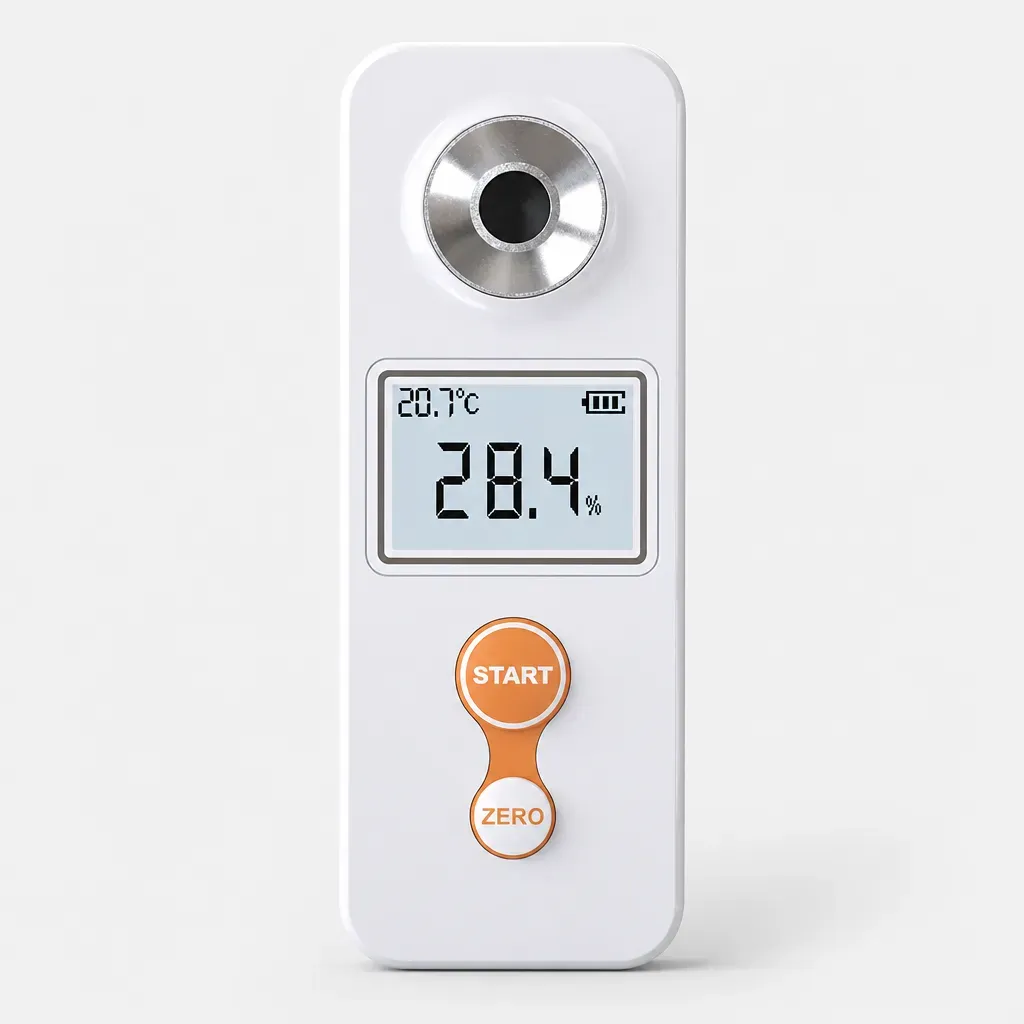
TL;DR: A 0-55 Brix refractometer measures dissolved sugar concentration in liquids such as juice, soft drinks, cordials and syrups. For many UK food and beverage businesses, this range is broad enough for routine quality control, while digital models with ATC help deliver faster, more repeatable readings.
Key Takeaways
- A 0-55 Brix refractometer is designed to measure dissolved sugar concentration across a range that suits fruit juice, soft drinks, syrups and routine beverage quality control.
- For many UK beverage producers, cafés, juice bars and food manufacturers, the 0-55 Brix range covers both low-sugar and moderately high-sugar liquids without needing multiple instruments.
- Digital models with ATC help improve repeatability, reduce operator error and speed up checks during daily production.
- Choosing the right unit depends on sample type, accuracy, ease of cleaning, calibration method, ingress protection and supplier support in the UK.
- A reliable Brix meter supports tighter batch consistency, better process control and clearer quality records for audits and internal traceability.
What Is a 0-55 Brix Refractometer?
A 0-55 Brix refractometer is a sugar-content measuring instrument used to check the concentration of dissolved solids, usually sugars, in liquids from 0 to 55 degrees Brix. In practical UK food and beverage use, it is commonly chosen for testing fruit juice, soft drinks, syrups and similar products where quick, repeatable readings matter.
Consistency is one of the first things customers notice in a drink. If a juice tastes weaker than the last bottle, or a syrup-based beverage pours sweeter than expected, confidence drops quickly. Therefore, the 0-55 Brix refractometer has become a practical quality control tool for UK beverage businesses that need fast, repeatable sugar readings without slowing production.
At HighPrecis, the focus is straightforward: digital Brix refractometer, Brix meter for juice, sugar content tester, 0-55 Brix refractometer, ATC Brix meter. Based on our testing of digital handheld units used in day-to-day beverage checks, the main value is speed and consistency. It gives teams a quick way to check dissolved sugar concentration in fruit juice, soft drinks and similar liquids, helping them maintain product consistency from batch to batch.
This guide explains what a 0-55 Brix refractometer measures, where it fits in UK operations, how to choose the right model, and what buyers should look for before placing an order.
What Does a 0-55 Brix Refractometer Measure?
A Brix refractometer measures how light bends as it passes through a liquid sample. That change in refraction is then used to estimate the concentration of dissolved solids, typically expressed as degrees Brix. In practical beverage work, Brix is widely used as an indicator of sugar content.
One degree Brix broadly represents 1 gram of sucrose in 100 grams of solution. However, in real-world drinks, the reading may also be influenced by other dissolved substances such as acids, flavourings or fruit solids. Therefore, Brix should be treated as a process control measurement rather than a full nutritional analysis.
A 0-55 Brix refractometer covers readings from very light liquids up to moderately concentrated sweet products. As a result, it is especially useful for:
- fruit juice and juice concentrates within working dilution stages
- soft drinks and cordials
- pre-mix beverage production
- sweetened tea and coffee applications in foodservice
- liquid ingredients used in desserts, sauces and flavour systems
The reason this range is so popular is coverage. It is broad enough for everyday beverage quality control, yet not so specialised that it becomes limited to one narrow production task.
Why Is the 0-55 Brix Range Useful for UK Beverage Quality Control?
Buying the correct range is one of the most important decisions. If the range is too low, samples can exceed the instrument’s limit. Conversely, if it is too high, some units sacrifice resolution where you need it most. A 0-55 Brix refractometer sits in a practical middle ground for many UK users.
Is it suitable for both low and moderately high sugar liquids?
Yes. Many drinks sold or produced in the UK fall comfortably within this window. Straight juices, diluted concentrates, syrups before final blending, flavoured waters, soft drinks and café beverage bases often need testing across a spread of sugar levels rather than at one fixed point. Consequently, a 0-55 Brix range allows one instrument to support several checks in the same workflow.
Can it be used for incoming, in-process and final product checks?
In practice, beverage teams often use Brix testing at three main stages:
- Incoming goods: checking juice, syrup or liquid ingredient consistency on delivery.
- In-process control: confirming blends and dilutions are hitting target specification.
- Final product checks: verifying the finished beverage remains within the expected profile before dispatch or service.
This flexibility is exactly why digital instruments are widely chosen for daily QC routines.
Why does Brix control matter in the UK market?
Sugar control matters commercially as well as technically. According to Public Health England’s Sugar reduction: report on progress between 2015 and 2019, sugar levels in soft drinks subject to the Soft Drinks Industry Levy fell by 44.3% between 2015 and 2019. That shows how strongly product formulation in the UK market has shifted towards tighter control of sweetness and composition.
For manufacturers and beverage operators, that market pressure makes reliable measurement more important. Therefore, a 0-55 Brix refractometer helps teams keep formulations closer to target while documenting consistent production standards.
Who Should Buy a 0-55 Brix Refractometer?
The strongest buyers are usually those who need fast readings, repeatable results and minimal training time. In the UK, that commonly includes:
- juice producers and bottlers
- soft drink manufacturers
- breweries and beverage development teams working with sweet liquid inputs
- food manufacturers using syrups, sauces or fruit preparations
- cafés, dessert operators and hospitality groups standardising drinks
- technical teams carrying out routine quality checks in small and mid-sized production settings
Based on our testing and product handling across food and beverage environments, the most common reason businesses move from occasional manual testing to a digital Brix meter is not complexity. Instead, it is repeatability. Staff turnover, busy shifts and high sample volumes all expose the weakness of methods that rely too heavily on technique or interpretation.
A dependable digital refractometer helps standardise the measurement, not just the product.
Should You Choose a Digital or Optical 0-55 Brix Refractometer?
When buyers compare options, the biggest decision is usually whether to choose a digital or optical instrument. For most commercial users, digital brings clearer advantages.
Why are digital models often the better fit?
- Faster reading display: results appear quickly on screen.
- Less operator subjectivity: there is no need to interpret a scale line through an eyepiece.
- Better repeatability: especially useful where several staff members perform checks.
- Easier staff training: new users can usually operate a digital unit with less ambiguity.
- Simpler record keeping: digital values are easier to log consistently in QA paperwork.
When might an optical refractometer still be suitable?
An optical model may still suit low-frequency testing, backup use or sites with very simple workflows. However, where speed, repeatability and ease of training are priorities, digital is usually the more practical choice.
What does ATC mean on a Brix refractometer?
ATC stands for automatic temperature compensation. Because sample temperature can affect refractive readings, ATC helps correct for normal temperature variation within the instrument’s stated range. As a result, it improves consistency during routine use, especially in busy kitchens, production rooms and goods-in areas.
How Accurate Is a 0-55 Brix Refractometer?
Accuracy depends on the model, calibration quality, sample handling and cleaning routine. In general, a good digital 0-55 Brix refractometer should provide stable, repeatable readings when used correctly and checked regularly against the manufacturer’s guidance.
In practice, repeatability is often just as important as headline accuracy. If your team can test the same sample several times and achieve closely matched results, the instrument is usually doing its job well for process control.
To get the best possible performance:
- calibrate as recommended before use
- use clean sample surfaces and clean water for rinsing
- avoid bubbles, pulp build-up or cross-contamination
- allow samples to settle when needed
- follow the supplier’s maintenance instructions
How Do You Use a 0-55 Brix Refractometer?
Although operation varies slightly by model, the basic process is straightforward:
- Calibrate the instrument according to the manufacturer’s instructions.
- Place a small amount of liquid sample on the measuring prism or sample well.
- Wait for the reading to stabilise.
- Record the Brix value.
- Clean the measuring surface before the next sample.
For best results, use a representative sample and keep the instrument clean between tests. Moreover, if you are checking pulpy or sticky liquids, careful cleaning becomes even more important for reliable readings.
What Should You Look for When Buying a 0-55 Brix Refractometer in the UK?
Not every unit with the same range offers the same day-to-day value. Therefore, buyers should look beyond the headline specification and focus on features that affect real working use.
What features matter most?
- Clear digital display: easier to read quickly during routine checks.
- ATC functionality: useful for consistent readings in varying ambient conditions.
- Simple calibration: saves time and reduces setup friction.
- Easy-clean sample area: important for sticky or coloured liquids.
- Suitable ingress protection: helpful in wet or high-use environments.
- Reliable UK supply and support: useful for replacement, warranty and aftersales queries.
Why does UK supplier support matter?
For many businesses, buying locally supported equipment reduces downtime and simplifies compliance paperwork. It can also make calibration advice, warranty handling and replacement decisions much more straightforward.
Is a 0-55 Brix Refractometer Right for Juice, Soft Drinks and Syrups?
Yes, in many cases it is. A 0-55 Brix refractometer is especially well suited to juice, soft drinks, cordials, beverage bases and many syrup applications that fall within that measurement range. As a result, it is often a sensible all-round choice for UK operators who want one instrument for several everyday liquids.
That said, the right choice still depends on your product range. If you routinely test very high-concentration samples beyond 55 Brix, or if you need specialised measurements beyond routine sugar control, you may need a different range or a more application-specific instrument.
Frequently Asked Questions About 0-55 Brix Refractometers
What is a 0-55 Brix refractometer used for?
It is used to measure dissolved sugar concentration in liquids such as juice, soft drinks, cordials and syrups. In UK operations, it is mainly used for routine quality control, batch consistency and formulation checks.
Is a 0-55 Brix refractometer accurate enough for production use?
For routine process control, yes, provided the instrument is calibrated correctly and used with clean, representative samples. Digital models are often preferred where repeatability matters across multiple users.
Can a 0-55 Brix refractometer measure drinks other than juice?
Yes. It can also be used on soft drinks, cordials, syrups, dessert liquids, flavour systems and other sweetened products within the stated range.
Do you need ATC on a Brix meter?
ATC is strongly recommended for most users because it helps compensate for normal sample temperature variation. Therefore, it supports more consistent readings in real working conditions.
Final Thoughts
A 0-55 Brix refractometer is a practical, versatile choice for many UK food and beverage businesses that need fast sugar readings across a useful working range. It suits everything from incoming goods checks to in-process control and final product verification.
Based on our testing, businesses usually get the best long-term value from a digital model that is easy to calibrate, simple to clean and backed by reliable UK support. Ultimately, the right instrument is the one that gives your team consistent readings with minimal friction during everyday use.
Ready to try HighPrecis?
Shop Now — £30.99