The Ultimate Guide to Sugar Content Tester in the UK
The Ultimate Guide to Sugar Content Tester in the UK
Consistency is expensive to lose. If a juice batch tastes thinner than yesterday’s, if a soft drink line drifts outside spec, or if incoming fruit varies more than expected, the problem usually shows up in flavour, waste, rework and customer complaints before it shows up in a report. A reliable sugar content tester helps prevent that. For UK beverage producers, farm shops, juice bars, contract packers and quality teams, it is one of the simplest tools for making fast, informed decisions.
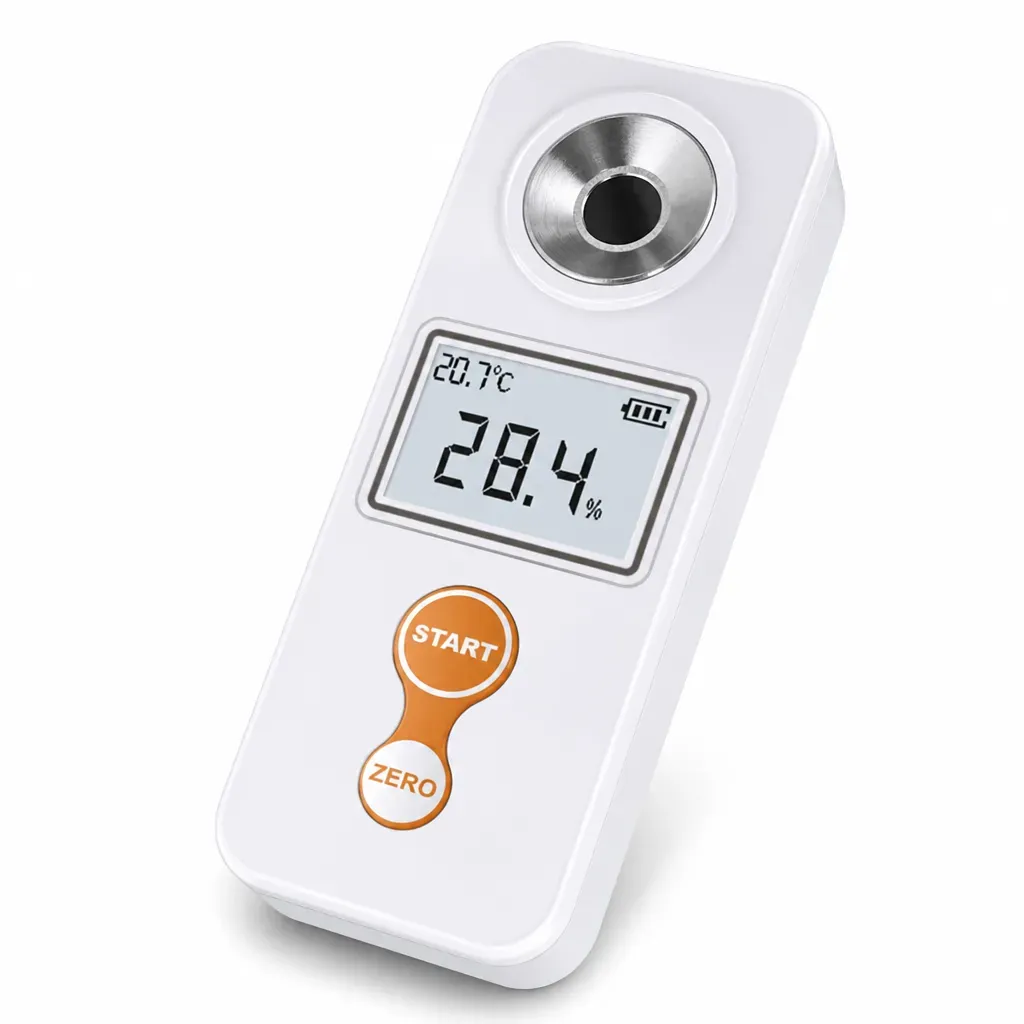
At HighPrecis, we work with buyers who need practical measurement equipment rather than lab complexity for its own sake. The focus is straightforward: quick, repeatable sugar readings for fruit juice, soft drinks and daily beverage QC. That is exactly where a digital Brix refractometer, often referred to as a Brix meter for juice, a 0-55 Brix refractometer or an ATC Brix meter, earns its place on the bench.
This guide explains what a sugar content tester does, how Brix testing works, where it fits into UK quality control, what accuracy and range really mean, and how to choose the right unit for routine use. It stays tightly focused on the keyword that matters here: sugar content tester.
Key Takeaways
- A sugar content tester measures dissolved solids, usually expressed as degrees Brix, to give a fast indication of sugar concentration in beverages and juice.
- For most juice, cordial and soft drink checks, a digital Brix refractometer offers faster, clearer and more repeatable readings than older manual methods.
- A 0-55 Brix refractometer suits a wide range of common beverage applications in the UK, from fresh juice to syrups used in production.
- ATC, or automatic temperature compensation, matters because sample temperature can affect readings and day-to-day consistency.
- Routine calibration, clean sampling practice and a documented test method are essential if you want trustworthy results for daily QC.
- According to the NHS, adults should have no more than 30g of free sugars a day, which keeps sugar measurement highly relevant for beverage formulation and labelling decisions in the UK.
What is a sugar content tester?
A sugar content tester is an instrument used to estimate the concentration of sugars dissolved in a liquid. In beverage work, that usually means fruit juice, juice blends, soft drinks, syrups, concentrates or other sweetened liquids. The most common measurement is degrees Brix, written as °Bx.
One degree Brix broadly represents 1 gram of sucrose in 100 grams of solution. In real production environments, especially with fruit juice and mixed beverages, a Brix reading represents the total soluble solids in the sample, not just sucrose alone. Even so, Brix remains the standard working figure because it is fast, useful and widely recognised across food and drink production.
When buyers search for a sugar content tester, they are often looking for a tool that answers practical questions:
- Is this juice batch ripe enough or sweet enough?
- Has this mix reached target concentration?
- Are incoming raw materials consistent?
- Has dilution been carried out correctly?
- Can the team release the batch with confidence?
That is why digital refractometers are so widely used. They offer a direct, easy-to-read result without relying on subjective interpretation of a scale line through an eyepiece.
How a sugar content tester works
The refractive index principle behind Brix testing
Most modern sugar content testers for drinks are refractometers. They work by measuring how light bends, or refracts, when it passes through a liquid sample. As the concentration of dissolved solids rises, the refractive index changes. The instrument converts that optical change into a Brix value.
In practical terms, you place a small amount of sample on the measuring prism, allow the reading to stabilise, and the device displays the sugar concentration. With a digital unit, this process is normally completed in seconds.
Why Brix is the preferred reading for beverage QC
Brix is widely used because it is quick to obtain and easy to track across production. A sugar content tester can help operators compare one batch with another, verify mixing ratios, monitor dilution and assess raw ingredient variation. That makes it useful from intake through to final checks.
For many UK businesses, the real value is operational rather than theoretical. A Brix reading gives staff a common quality language. Production, purchasing and QC teams can all work to the same target figures.
Digital versus manual sugar content tester options
Manual optical refractometers still exist, but digital instruments have clear advantages for many buyers:
- They reduce user interpretation errors.
- They are easier to use in mixed lighting conditions.
- They often provide faster readouts.
- They support more repeatable day-to-day checks.
- They are more accessible for teams with multiple operators.
For a busy juice room or beverage production line, those benefits translate into less hesitation and more dependable decisions.
Why a sugar content tester matters in the UK market
Meeting consumer expectations for consistency
British shoppers notice when a product’s flavour profile shifts. Whether the item is a fresh apple juice sold in a farm shop, a bottled lemonade produced by a regional drinks brand, or a premium cordial supplied to hospitality, sweetness consistency has a direct effect on repeat purchase.
A sugar content tester helps reduce avoidable variation. If the target Brix is set correctly, operators can check whether each batch is aligned before it reaches customers.
Supporting formulation and sugar awareness
Sugar remains a major public health topic in the UK. The NHS advises that adults should have no more than 30g of free sugars a day, while children aged 7 to 10 should have no more than 24g a day and children aged 4 to 6 no more than 19g a day. Source: NHS, “How does sugar in our diet affect our health?”.
That matters because manufacturers and drink developers are under constant pressure to manage sweetness, balance taste and provide accurate nutritional information. A sugar content tester is not a complete nutritional labelling solution by itself, but it is a valuable front-line tool for monitoring concentration during product development and production.
Useful for UK compliance and quality systems
In the UK, food and drink businesses operate within a framework that places clear responsibility on producers for safe, accurately described products. Depending on the product and process, businesses may work within HACCP-based quality systems, customer specifications, retailer standards and internal release criteria.
A sugar content tester supports these systems by generating a measurable control point for sweetness and concentration. It is especially useful where Brix limits are written into product specifications or production records.
For businesses selling packaged drinks, Brix testing can also support internal checks related to formulation consistency before more formal analytical or labelling workflows are completed.
Where a sugar content tester is used
Fruit juice production
This is one of the most common applications. A Brix meter for juice helps producers assess fruit maturity, blend batches, standardise sweetness and monitor finished product concentration. Apple, orange, grape, berry and tropical juice lines can all benefit from quick checks.
Soft drinks and cordial manufacture
For soft drinks, a sugar content tester helps verify syrup concentration and final dilution. If the drink tastes off, checking Brix is often one of the first diagnostic steps because it quickly shows whether the solids concentration sits inside target tolerance.
Juice bars, catering and hospitality
Smaller operators also use sugar content testers to maintain quality when recipes depend on fresh ingredients that naturally vary from day to day. A digital reading helps take guesswork out of menu consistency.
Incoming goods inspection
For businesses buying fruit juice, concentrate or sweetened ingredients from suppliers, Brix testing can be part of intake inspection. A quick measurement helps flag lots that may need further review before use.
Product development and recipe scaling
During trials, a sugar content tester helps teams compare prototypes objectively. It can speed up the move from bench recipe to production recipe by providing a clear concentration reference point that can be repeated.
Understanding Brix ranges when choosing a sugar content tester
Why the 0-55 Brix range is so useful
A 0-55 Brix refractometer covers a wide section of beverage applications. It is broad enough for many fruit juices, juice blends, soft drinks and syrups, while still offering suitable resolution for routine checks.
For many UK buyers, this range is practical because it aligns with everyday beverage QC rather than niche extremes. Instead of overcomplicating the purchase, it keeps the instrument matched to common working needs.
Examples of sample types within this range
- Fresh orange juice
- Apple juice
- Pressed berry blends
- Soft drink syrups
- Cordial concentrates within working limits
- Sweetened beverage blends used in production
Exact readings vary by formulation, processing and brand specification, but the point is clear: a 0-55 Brix instrument is versatile enough for a large share of standard beverage testing tasks.
When range affects buying decisions
If your products regularly sit at the lower end of sweetness, you still need a sugar content tester that reads accurately in that part of the scale. If you also handle syrups or concentrates, enough top-end range matters too. The best instrument is not the one with the longest specification sheet. It is the one whose range, resolution and ease of use fit your routine samples.
Why ATC matters in a sugar content tester
What ATC means
ATC stands for automatic temperature compensation. Because temperature affects refractive index, it can influence Brix readings. In a production setting, that matters more than many first-time buyers expect.
How ATC improves daily repeatability
If one operator tests a chilled sample from storage and another checks a warmer sample near the line, readings can drift if temperature effects are not handled properly. An ATC Brix meter helps correct for that and improves consistency across normal working conditions.
It does not remove the need for good practice. Samples should still be handled consistently, and the instrument should be used within its specified operating conditions. But ATC reduces a major source of variation in routine work.
Why UK buyers should pay attention to temperature compensation
British workplaces can see notable seasonal variation, particularly in smaller production units, prep rooms, farm shops and mixed-use food sites where ambient conditions are less controlled than in a large lab. ATC is therefore a practical feature, not a marketing extra.
What to look for when buying a sugar content tester
Accuracy and repeatability
Accuracy matters, but repeatability is often just as important in day-to-day QC. If the same sample gives noticeably different readings when tested repeatedly under the same conditions, the instrument will create more questions than answers. Look for a sugar content tester designed for stable, repeatable performance.
Clear digital display
Fast decision-making depends on being able to read results immediately. A bright, unambiguous digital display can reduce handling errors and improve operator confidence.
Simple calibration procedure
Calibration should be straightforward enough that staff actually do it at the required frequency. A complicated process tends to be skipped, and that undermines trust in results.
Sample size and speed
In a busy environment, a sugar content tester should deliver a reading from a small sample volume and do so quickly. That makes it easier to incorporate testing into normal workflow without slowing the line or creating a bottleneck.
Build quality and cleaning practicality
Sugary liquids are sticky. Juice pulp can cling to surfaces. Equipment used in beverage environments must be easy to wipe down and robust enough for repeated handling. A fragile instrument quickly becomes a false economy.
Suitable application range
The unit should match your real products. For many users, a digital Brix refractometer with a 0-55 Brix range is a sensible fit for juice and soft drinks. It covers everyday use without sacrificing usability.
Supplier reliability
Trust matters in measurement equipment. Buyers should be able to identify who is selling the product, what the specification means, and where support sits if questions arise. This is part of E-E-A-T in practical ecommerce terms: experience with the application, technical expertise, a clear trading identity and transparent product information.
How to use a sugar content tester properly
A simple step-by-step method
- Check that the sugar content tester is clean, calibrated and ready for use.
- Prepare a representative sample. Avoid testing an unblended portion if the batch is not uniform.
- If needed, remove bubbles or excess foam because these can affect the optical reading.
- Place the sample on the prism or measuring well according to the instrument instructions.
- Wait for the reading to stabilise.
- Record the Brix result with batch details, time and operator if this forms part of your QC record.
- Clean the measurement surface thoroughly before the next test.
Good sampling practice matters as much as the instrument
Even an excellent sugar content tester cannot rescue a poor sample. If pulp settles, syrup stratifies, or the drink has not been mixed properly, the number on screen may be precise but still unrepresentative. That is why written sampling procedures are worth having, even in smaller businesses.
Common mistakes to avoid
- Testing a sample that is not representative of the batch
- Failing to clean sticky residue between samples
- Skipping calibration checks
- Ignoring temperature handling
- Recording the result without the batch context
- Assuming Brix alone gives a complete nutritional sugar declaration
Calibration and maintenance of a sugar content tester
Why calibration is non-negotiable
If you rely on Brix readings to accept raw materials, release batches or investigate process variation, calibration cannot be an afterthought. A sugar content tester should be checked in line with the manufacturer’s instructions and your internal quality procedures.
Routine maintenance points
- Keep the prism and sample area clean.
- Use appropriate calibration standards or reference materials where specified.
- Store the instrument in suitable conditions.
- Protect it from knocks, contamination and unnecessary moisture exposure.
- Review battery condition if the unit is battery powered.
Documentation builds trust
For UK businesses operating under formal quality systems, it is good practice to document calibration checks and any maintenance events. That record supports traceability and gives confidence that Brix data is dependable when questions arise later.
How a sugar content tester supports better business decisions
Reducing batch variation
Variation leads to complaints, adjustments and waste. A sugar content tester gives operators an immediate checkpoint before issues move downstream. That helps standardise flavour and mouthfeel across batches.
Cutting rework and waste
If a beverage is found to be out of spec only after filling or dispatch preparation, the cost increases sharply. Earlier Brix checks can catch concentration problems before packaging materials, labour and time are committed.
Improving communication between teams
A measurable Brix target creates a clearer handover between procurement, production and QC. Instead of subjective descriptions such as “a bit weak” or “too sweet”, teams can work against defined numbers and tolerances.
Supporting brand reputation
For independent British drinks brands, repeatability is a competitive advantage. Customers expect the same profile each time they buy. A sugar content tester is a small tool with a direct influence on that outcome.
Choosing a sugar content tester for juice and soft drinks
What most UK buyers actually need
Most buyers are not looking for a complicated lab system. They want an instrument that is accurate enough for daily decisions, quick to use, simple to clean and dependable in ordinary production conditions. That is why the product category described as a digital Brix refractometer, Brix meter for juice, 0-55 Brix refractometer and ATC Brix meter is so relevant.
Why this specification makes sense
That combination aligns with typical beverage workflows:
- Digital for clarity and repeatability
- Brix for recognised sugar concentration control
- 0-55 range for broad beverage usefulness
- ATC for more stable readings in normal working conditions
For juice, soft drinks and routine beverage QC, that specification is practical rather than excessive.
Why HighPrecis is relevant for buyers searching for a sugar content tester
HighPrecis positions this product around the real job it needs to do: quick, repeatable sugar readings for fruit juice, soft drinks and daily beverage QC. That matters because measurement equipment should be judged by usefulness at the point of testing, not by inflated marketing language.
The product narrative is clear and application-led: Digital Brix Refractometer, Brix meter for juice, sugar content tester, 0-55 Brix refractometer, ATC Brix meter. For buyers comparing options, that clarity is valuable. It signals that the instrument is intended for routine beverage concentration checks rather than a vague list of unrelated uses.
From an ecommerce trust perspective, buyers should expect transparent specifications, clear product descriptions and a close match between listed features and actual use cases. That is the standard HighPrecis buyers are usually looking for when selecting a sugar content tester for commercial work.
Call to action: find the right sugar content tester for daily QC
If you need a practical instrument for checking juice, soft drinks or beverage mixes, a dedicated digital Brix unit is the sensible place to start. The right sugar content tester helps your team move faster, record more reliable data and maintain product consistency with less guesswork.
Explore the HighPrecis product page for a solution built around routine beverage testing: HighPrecis digital Brix refractometer.
For businesses that want a Brix meter for juice with a 0-55 Brix range and ATC, this is the specification that fits everyday quality control work.
Frequently Asked Questions
What does a sugar content tester measure?
A sugar content tester usually measures the refractive index of a liquid and converts it into a Brix reading. In beverages, that reading indicates total soluble solids and is commonly used as a practical measure of sugar concentration.
Is a sugar content tester the same as a Brix meter?
In most beverage applications, yes. Many buyers use the terms interchangeably. A digital Brix refractometer is one of the most common types of sugar content tester used for juice and soft drinks.
Why is ATC important in a sugar content tester?
ATC, or automatic temperature compensation, helps correct for the effect temperature can have on readings. This improves consistency when samples are tested under different normal working temperatures.
Can a sugar content tester be used for fruit juice and soft drinks?
Yes. A suitable digital unit, particularly a 0-55 Brix refractometer, is commonly used for fruit juice, soft drinks, syrups and other beverage QC applications, provided the sample type sits within the instrument’s specification.
Ready to try HighPrecis?
Shop Now — £30.99